Address
Bldg-1, No.19, Yunpu 1st Road, Huangpu District, Guangzhou, Guangdong, China, 510530
Work Hours
Monday to Friday: 8:30AM - 5:30PM
Address
Bldg-1, No.19, Yunpu 1st Road, Huangpu District, Guangzhou, Guangdong, China, 510530
Work Hours
Monday to Friday: 8:30AM - 5:30PM

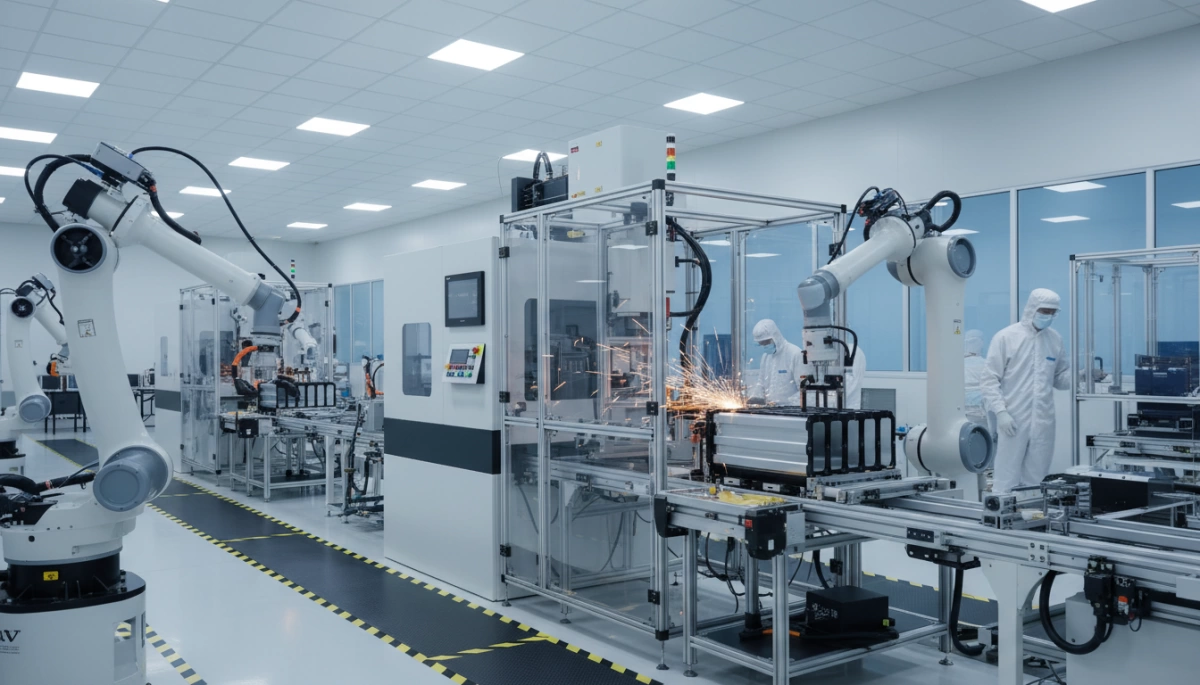
Are you struggling to scale your battery module assembly while maintaining microscopic precision and absolute safety?
As an automation integrator with over 20 years of high-tech experience, we know that designing a flawless EV battery manufacturing line is one of the toughest challenges in engineering today.
You might already know that hitting maximum cell-per-hour output requires more than just piecing together fragmented equipment. It requires a seamless, end-to-end system.
In this guide, you’re going to learn exactly how to optimize your battery pack production line, step by step.
We will break down the critical automated processes—from robotic cell sorting and precision thermal interface material (TIM) dispensing to rigorous electrolyte leak detection.
So if you are looking to deploy reliable, turnkey automation solutions that eliminate thermal runaways and future-proof your factory floor, this guide is for you.
Let’s dive right in.
When I look at the pressure facing EV battery manufacturing and energy storage systems (ESS) production today, the core anxiety is always the same: how do we scale output without compromising thermal safety or precision? The secret isn’t just in the cell chemistry; it is in the flawless execution of your battery module assembly.
Individual battery cells are powerful, but they are also fragile and volatile on their own. By grouping them into robust modules, we create a stable, manageable unit that protects against physical shocks and mitigates thermal runaway. A highly controlled battery module assembly process is the absolute foundation of any reliable, long-lasting energy storage solution.
Modules act as the vital structural bridge between raw chemical power and the final application. They organize delicate cells into a unified block, providing the necessary framework before integration into the final battery pack.
Here is what a properly assembled module achieves:
The battery industry is evolving at breakneck speed. While cell-to-pack (CTP) design is making aggressive headlines to reduce weight, traditional battery module assembly remains non-negotiable for applications requiring maximum serviceability, rigorous thermal control, and format flexibility. Whether you are dealing with prismatic or cylindrical formats, today’s manufacturing landscape demands high-speed, turnkey automation solutions to handle the intense throughput required by modern power grids and electric fleets.
When we approach battery module assembly, precision and repeatability are our top priorities. Modern EV battery manufacturing relies heavily on turnkey automation solutions to ensure every unit is safe and efficient. Here is how we break down the robotic battery assembly process from individual units to a cohesive module.
Before any physical building begins, we have to prepare and grade the raw materials. Consistency across every cell is mandatory to ensure the longevity of the final product.
Once sorted, the cells are physically arranged into their structural format. Whether we are handling prismatic units or building cylindrical battery modules, the physical layout must be perfect.
Cells need to stay structurally secure while effectively managing the heat they generate during operation.
The final step in this sequence is linking the individual cells so power can flow efficiently through the module.
Scaling up EV battery manufacturing means facing intense production bottlenecks. In our experience building turnkey automation solutions, hitting high volumes without sacrificing safety or performance comes down to mastering three core hurdles.
Heat destroys battery life and compromises safety. Handling heat dissipation is non-negotiable for any reliable energy storage system (ESS).
We have to balance raw speed with microscopic accuracy to keep the battery pack production line profitable.
Battery tech evolves rapidly. Locking your production floor into a single, rigid cell format is a massive financial risk.
In EV battery manufacturing, safety is our absolute baseline. Building a reliable battery module assembly requires strict, non-negotiable validation before it ever reaches a vehicle or storage grid.
Before any unit leaves our floor, it undergoes rigorous End-of-line (EOL) battery testing. We verify the electrical integrity of every module to guarantee peak performance.
A compromised seal can shut down an entire energy storage system. We integrate precise leak detection directly into our production lines to keep moisture out and active chemicals securely inside.
This is a critical focus for EV battery quality control. Escaping electrolyte leads to rapid battery degradation and serious thermal risks. We deploy advanced, automated sniffing technology to detect even trace electrolyte vapors along the assembly line. By isolating these microscopic leaks instantly, we ensure that every single module produced is stable, secure, and ready for long-term deployment.
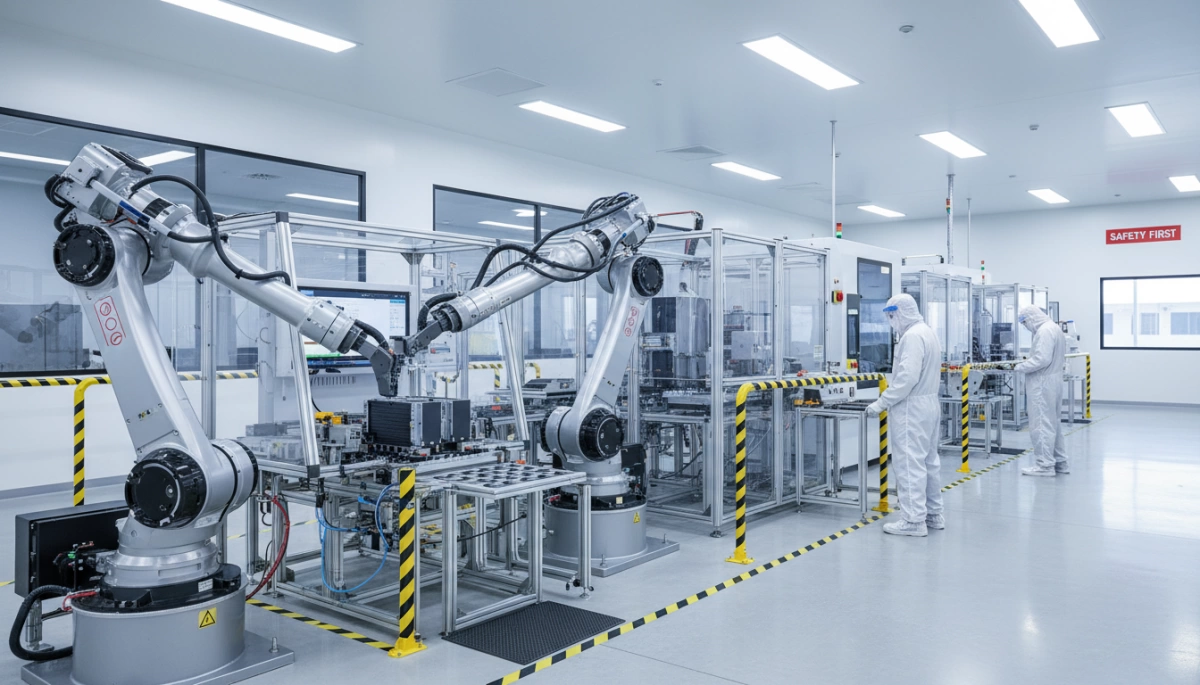
When scaling up EV battery manufacturing, patching together equipment from different vendors is a quick way to guarantee downtime. We constantly see manufacturers struggle with production bottlenecks simply because their machines cannot communicate with each other. Partnering with an experienced integrator eliminates this headache by delivering a cohesive, fully connected system from day one.
Running a profitable battery pack production line means leaving fragmented machinery behind. When you force incompatible machines to handle delicate tasks like robotic battery assembly, you sacrifice speed and compromise product safety. You need turnkey automation solutions that unify the entire floor. A fully integrated setup ensures that every mechanical handoff and data point is perfectly synchronized, dramatically reducing scrap rates and keeping your line moving.
We built Upton to solve the exact bottlenecks that slow down global production. When you partner with us for your battery module assembly, you get more than just hardware. You get a proven, reliable framework built for scale.
Here is what we bring directly to your energy storage systems (ESS) production:
In traditional battery module assembly, we group individual cells into an intermediate unit—the module—before installing them into the main battery pack. This approach offers excellent structural protection, easier thermal management, and straightforward maintenance if a single module fails.
Conversely, Cell-to-pack (CTP) design eliminates the module phase entirely. We integrate the cells directly into the final pack structure. While CTP reduces weight and maximizes spatial efficiency for higher energy density, standard module assembly remains the go-to method for energy storage systems (ESS) production and vehicles requiring high modularity and robust physical shielding.
Creating secure, low-resistance electrical connections is a cornerstone of EV battery manufacturing. To achieve this at scale, we rely on highly controlled automated systems:
A compromised seal can lead to thermal runaway or total system failure. To guarantee absolute safety on the battery pack production line, we implement multiple layers of automated testing:
