Address
Bldg-1, No.19, Yunpu 1st Road, Huangpu District, Guangzhou, Guangdong, China, 510530

Work Hours
Monday to Friday: 8:30AM - 5:30PM

Battery Pack Assembly Equipment Guide for EV Production

Are you struggling with throughput bottlenecks or worrying about field failures in your EV battery assembly line? As manufacturers, we know that hitting GWh-level production without sacrificing quality is what keeps us up at night. The foundation of any high-performance automated battery production line starts with dialing in the core stages of your lithium battery pack assembly. Let’s break down the critical steps where precision and reliable battery pack assembly equipment make all the difference.

Core Stages of Battery Pack Assembly

Building a robust power system requires absolute precision at every single checkpoint. Here is how we approach the battery module assembly process to guarantee mechanical integrity, electrical performance, and fast delivery to the market.
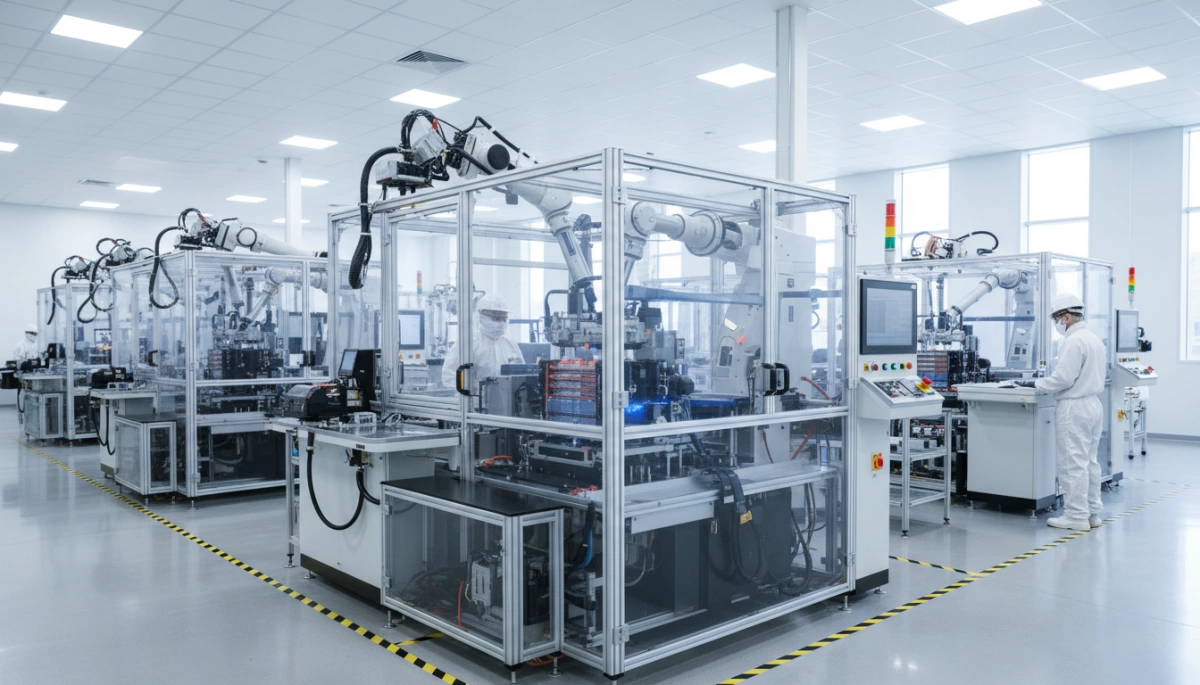
Battery Cell Sorting Machine

  • Cell Sorting and Grading: You cannot build a durable pack with mismatched cells. Utilizing a high-speed battery cell sorting machine to perfectly match voltage and internal resistance (IR) is non-negotiable. Maintaining tight tolerances at this stage prevents premature degradation and ensures long-term pack longevity.

Insulation and Matrix Preparation

  • Terminal Insulation: Applying positive terminal insulation with pinpoint accuracy is critical to preventing catastrophic short circuits during field use.
  • Matrix Placement: Cells are prepped and seamlessly loaded into their structural matrices, setting the baseline for rigid, high-quality module alignment.

Automated Laser Welding Battery

  • Welding Technologies: Solid busbar connections are the heartbeat of battery manufacturing automation. While a reliable spot welding machine for battery pack assembly makes sense for smaller or specialized runs, high-power fiber laser welding is the gold standard for heavy-duty EV modules. Implementing automated laser welding battery systems delivers the deep, clean penetration required for superior thermal and electrical conductivity.

BMS Integration

  • Assembling the Brain: Integrating the Battery Management System (BMS) requires flawless wire routing and secure connections. This critical component actively manages thermal loads and voltage balancing, dictating the overall safety and lifecycle of the final product.

Housing and Sealing

  • Mechanical Integrity: The process wraps up by securing the cell matrix and BMS into a rugged enclosure. Proper housing and tight environmental sealing protect the module against vibration, moisture, and impact, ensuring the pack survives harsh, real-world conditions.

Categorizing Battery Pack Assembly Equipment by Automation Level

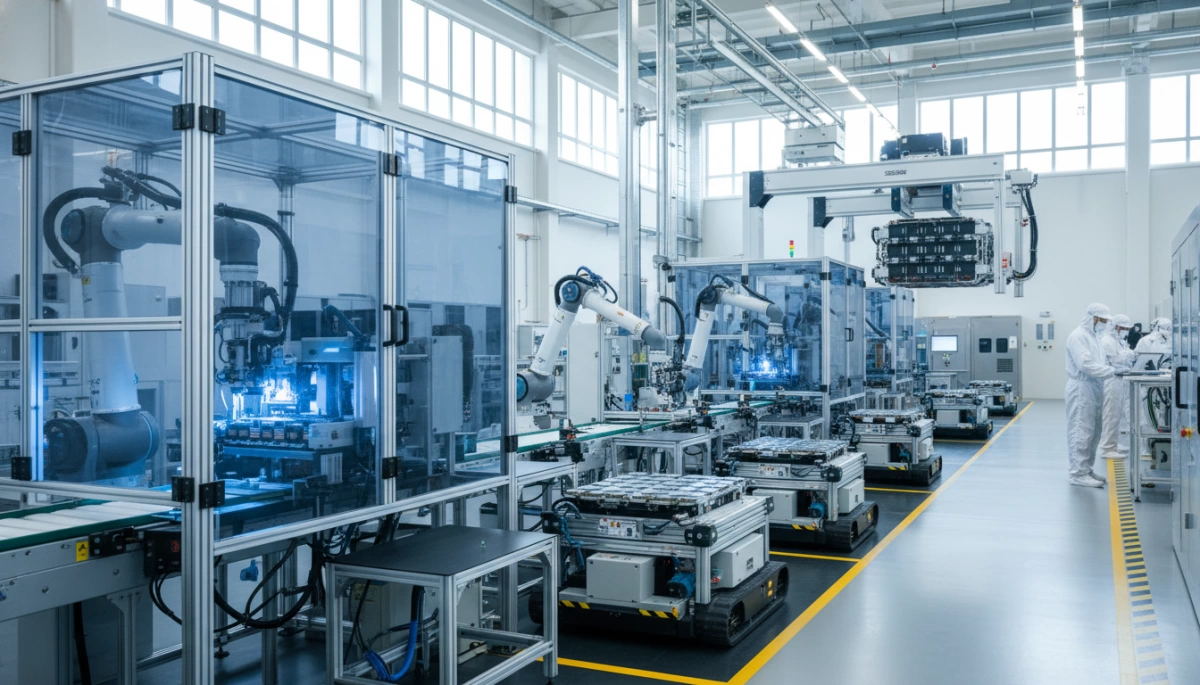
battery pack assembly automation levels

When setting up your facility, selecting the right battery pack assembly equipment comes down to your production goals and scale. We categorize these setups into three main automation levels to match different manufacturing needs.

Manual and Lab-Scale Equipment

If you are focusing on R&D or pilot runs, manual setups are the go-to choice.

  • Best for: Testing new cell chemistries and handling low-volume runs.
  • Advantage: Offers maximum flexibility without heavy upfront capital.
  • Use Case: Prototyping and early-stage testing before scaling up to a full EV battery assembly line.

Semi-Automatic Production Lines

For mid-scale operations, battery manufacturing automation does not have to be an all-or-nothing investment. Semi-automatic lines effectively bridge the gap.

  • Best for: Facilities needing higher throughput than manual labs but without the scale for full automation.
  • Advantage: Perfectly balances labor costs with machine efficiency.
  • Use Case: Regional battery module assembly processes where human oversight is still preferred for specific handling and visual quality checks.

Fully Automated Turnkey Solutions

When you are targeting GWh-level production, manual intervention slows everything down. You need a complete turnkey battery assembly line.

  • Best for: Massive scale operations demanding maximum Parts Per Minute (PPM).
  • Advantage: Minimizes human error and drastically cuts down production time.
  • Use Case: High-speed automated battery production line setups designed to meet the extreme demands of the global electric vehicle market.

Tailoring Battery Pack Assembly Equipment to Cell Formats

We know that a one-size-fits-all approach does not work in battery manufacturing. The type of cell you use dictates the exact machinery you need on your floor. To build a reliable product, your battery pack assembly equipment must be optimized for the specific physical demands of the cell format. Here is how we tailor the setup for the big three formats.

Cylindrical Cell Assembly Line

When dealing with 18650, 21700, or the larger 4680 formats, production is a numbers game. You are managing thousands of individual cells, which means speed and extreme precision are non-negotiable.

  • High-Speed Processing: We integrate a rapid battery cell sorting machine to grade and align thousands of units smoothly without creating a bottleneck.
  • Complex Connections: The sheer volume of connections requires a top-tier automated laser welding battery setup to secure busbars rapidly and cleanly.

Prismatic Battery Manufacturing

Prismatic cells are the heavyweights. Because of their size and rigid casing, they are the go-to format for an industrial EV battery assembly line.

  • Heavy Material Handling: Our machinery is built to grip, lift, and place heavier formats without dropping them or stressing the outer casing.
  • Structural Focus: The battery module assembly process here is designed around rigid stacking and compression to ensure the final pack can handle intense road vibrations.

Pouch Cell Handling

Pouch cells offer incredible flexibility and energy density, but they are fragile. Our lithium battery pack assembly process relies on highly specialized robotics to manage them safely.

  • Puncture Prevention: We use tailored vacuum suction cups and soft-touch automation to move the cells, completely eliminating the risk of foil puncturing.
  • Expansion Management: The automated battery production line factors in the natural swelling of pouch cells during their charge cycles, ensuring the final module frame accommodates expansion without warping.

Battery Pack Testing Equipment for Leak Detection

In EV battery architecture, quality control is never an afterthought. When we deploy our battery pack assembly equipment, rigorous testing and leak detection are built directly into the core manufacturing process. A compromised module is a major safety hazard, not just a simple defect. That is why having reliable testing stations on the factory floor is completely non-negotiable for any serious production run.

To guarantee total safety and longevity, we implement a multi-layered testing approach:

  • Air Leak Testing: This serves as our baseline defense. We use fast, automated air pressure decay tests to ensure all basic environmental seals are intact. This keeps everyday moisture and road debris out of the module.
  • Helium Leak Testing: For high-stakes EV battery housings, standard air tests just don’t cut it. We integrate precise helium leak testing battery solutions to detect microscopic fissures. Because helium atoms are incredibly small, they easily escape through invisible cracks, allowing us to identify mechanical flaws before they become real-world failures.
  • Electrolyte Leak Detection: Preventing chemical exposure is the ultimate safety benchmark. We use an advanced electrolyte leak test system, such as the MSQ2000, for a deep dive into safety assurance. This equipment instantly sniffs out escaping solvent vapors, ensuring no leaking cells make it past the assembly line.

Choosing Your Battery Pack Assembly Equipment Partner

When investing in an automated battery production line, the machinery is only half the equation. The manufacturer behind the gear determines your production success. Here is what I look for when selecting a partner to build a reliable EV battery assembly line.

Proven Automation Experience

Don’t risk your facility on a novice team. Demand partners with decades of background in high-tech battery manufacturing automation. Deep design experience translates directly to higher efficiency, less material waste, and fewer operational bottlenecks on your floor.

Custom Turnkey Battery Assembly Lines

Off-the-shelf solutions rarely fit complex modern module designs. Your cell formats, BMS integrations, and safety parameters are unique. You need completely customized, turnkey battery assembly lines tailored to your exact throughput and chemistry requirements.

Fast Delivery and Project Management

Industrial machinery often faces major global supply chain delays. A competent manufacturing partner uses rigid project management and in-house fabrication to ensure fast delivery. Getting your lithium battery pack assembly gear delivered, installed, and commissioned on schedule is non-negotiable.

Proactive Lifecycle Support

The business relationship starts at installation; it doesn’t end there. Look for aggressive, proactive post-installation service. Responsive troubleshooting, spare parts availability, and routine maintenance prevent expensive factory downtime.

Partner Evaluation Matrix

Evaluation MetricWhat to DemandWhy It Matters
Design Heritage10+ years in industrial automationEnsures complex battery pack assembly equipment runs flawlessly from day one.
Solution TypeHighly customized turnkey setupsFits exact module designs rather than forcing your product into standard machine templates.
Delivery SpeedTransparent, agile timelinesBeats global supply chain delays so you can hit the market faster.
Post-Sale ServiceProactive lifecycle supportMaximizes uptime, minimizes friction, and extends the overall lifespan of the machinery.

Related Sources

https://www.quantumscape.com/blog/ev-battery-cell-formats-for-lithium-metal/`
https://www.inficon.com/en/news/battery-modules-tests-with-elt-vmax`