Address
Bldg-1, No.19, Yunpu 1st Road, Huangpu District, Guangzhou, Guangdong, China, 510530

Work Hours
Monday to Friday: 8:30AM - 5:30PM

EV Test Systems Guide Standards Safety and Leak Detection

Deconstructing EV Test Systems: Core Focus Areas

When scaling EV manufacturing, we know the primary battle engineers face is validating complex power architectures without bottlenecking the assembly line. With over two decades of industry experience at Upton, we engineer EV test systems that don’t just catch faults—they accelerate your time-to-market. Here is a breakdown of the core focus areas required for a resilient production line.

High-Voltage Battery Testing

How do you ensure battery packs survive extreme road loads without draining your facility’s energy grid? It requires precise validation of capacity, lifespan, and thermal limits.

  • Road Load Profiling: Validate thermal limits and lifespan under simulated, real-world stress conditions to ensure structural and chemical safety.
  • Regenerative Power Test Benches: High-capacity testing consumes massive energy. We integrate energy-efficient regenerative systems to recapture absorbed power during test cycles, drastically cutting your operational overhead.

High-Dynamic Motor Testing

Catching torque anomalies early requires testing environments that react faster than the vehicle itself.

  • Drivetrain Dynamometers: We target motor efficiency, precise torque mapping, and high-dynamic response times (strictly under 10ms) to ensure absolute drivetrain reliability.
  • Hardware-in-the-Loop (HIL) Simulation: Stop waiting for physical prototypes. HIL simulation allows you to mimic real-world conditions instantly, validating control software against physical hardware to eliminate development delays.

End-of-Line (EOL) Testing Automation

If your production line is moving fast but your quality assurance is lagging, you have a critical scalability issue.

  • Eliminating Bottlenecks: Manual inspections simply cannot keep pace with modern gigafactory output.
  • Battery Cell Robotic Integration: We deploy automated robotic integrations for End-of-Line (EOL) testing automation. This ensures every completed module undergoes rigorous, repeatable quality assurance without sacrificing your factory throughput.

The Non-Negotiable Role of Leak Detection in EV Test Systems

When we design and implement EV test systems, relying solely on standard mechanical stress tests just doesn’t cut it anymore. If a battery pack has even the smallest structural compromise, moisture can seep in, or hazardous chemicals can leak out. This environmental exposure is exactly what leads to battery thermal runaway—a catastrophic failure that puts end-users at risk and destroys brand trust. Proper leak detection is a hard requirement for electrical safety testing.

Essential EV Battery Leak Testing Methods

To guarantee absolute safety and reliable power architecture validation, modern automated test setups must include specific leak detection protocols. Here is how we break down the necessary checks:
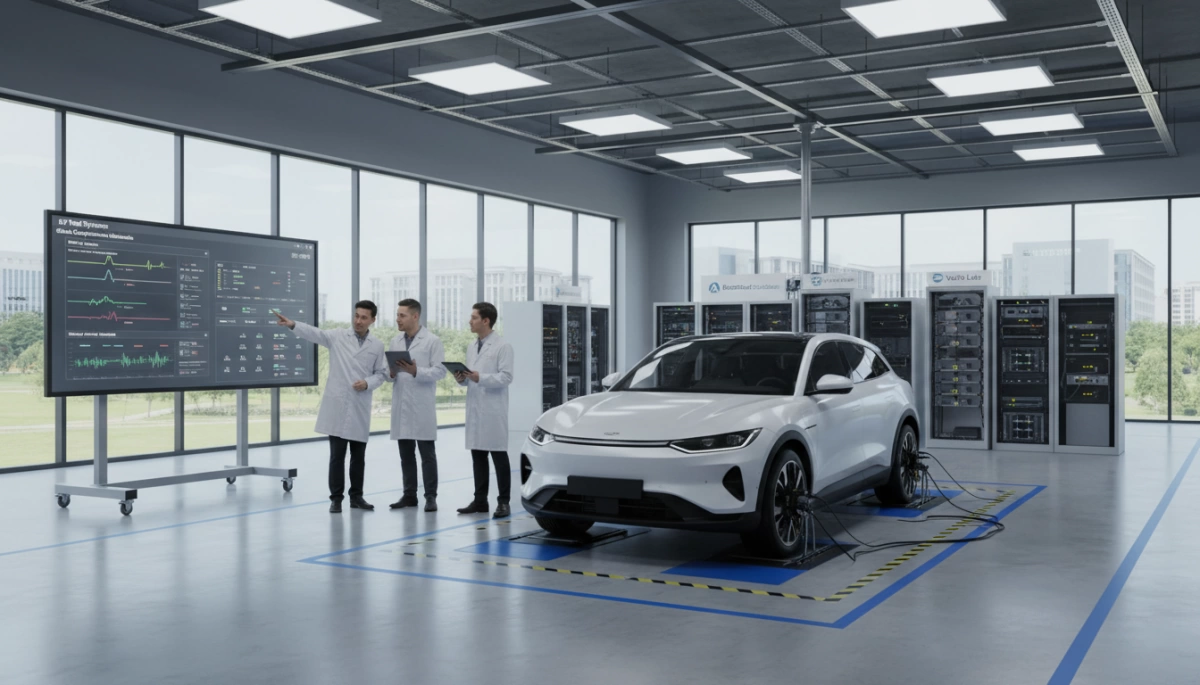
  • Air Leak Testing: This is the practical baseline. We use air pressure to verify the general structural integrity of the battery housing and cooling channels, catching obvious manufacturing defects quickly.
  • Helium Leak Testing for Batteries: When precision is non-negotiable, we bring in helium. Because helium gas molecules are incredibly small, this method spots micro-leaks in the pack’s housing that air testing might miss, ensuring the tightest possible seal.
  • Electrolyte Leak Detection System: A specialized approach for modern energy storage. Even if the outer casing holds, the internal pouch or prismatic cells might leak. This system actively sniffs out trace amounts of vaporized battery fluid, tackling the unique challenges of modern EV battery module assembly head-on.

Meeting Global Standards for EV Test Systems

EV test systems automotive compliance standards

Navigating the automotive compliance landscape is complex, but it is a non-negotiable reality in our industry. When we evaluate and deploy EV test systems, we know that meeting global testing standards from day one is the only way to ensure safety, reliability, and international market access.

You cannot afford guesswork during procurement. Your equipment must align with strict, recognized global benchmarks. Here are the key standard categories we prioritize when securing reliable test setups:

  • Automotive EMC Standard Compliance: High-voltage systems generate interference. Your testing environment must meet stringent EMC/EMI shielding standards, such as CISPR25, to guarantee that vehicle electronics remain completely unaffected.
  • OEM Testing Standards (VW 80300 / LV 124): European and manufacturer-specific electrical regulations are highly demanding. Test setups must handle exact OEM requirements, including LV 148, to ensure thorough electrical safety testing (HiPot) and rigorous power architecture validation.
  • Performance and Range Validation: The hardware must natively support standardized EPA and SAE battery range procedures. This is critical for accurately verifying real-world mileage and efficiency without compliance pushback.

Procuring EV Test Systems: Turnkey vs. Modular

When we look at how facilities build out their testing lines, the biggest trap we see is the mix-and-match approach. Buying different pieces of equipment from multiple vendors to create modular upgrades sounds flexible, but it usually backfires. You almost always run into data silos where different software platforms simply refuse to communicate. Ultimately, this leads to costly integration failures that can bring your entire production to a standstill.

The Advantage of Turnkey EV Testing Solutions

This is exactly why we champion an end-to-end approach. Partnering with a single automation and testing provider for your EV test systems removes the guesswork. When everything is built to work together natively—from initial EV battery module assembly checks to the final rollout—you eliminate compatibility headaches. A unified system keeps your data centralized, actionable, and secure.

Key Vendor Evaluation Metrics

When you are ready to choose a testing partner to support your global operations, you have to look past the basic equipment spec sheets. Here is what actually dictates long-term success:

  • Decades of Design Experience: You need a partner who has evolved alongside the EV industry and knows how to avoid hidden integration traps.
  • Comprehensive Project Management: Look for a provider that offers a single point of contact to manage the entire project lifecycle, from initial design through final installation.
  • Fast Delivery Timelines: Speed to market is everything. Your vendor must have a proven track record of rapidly deploying complex systems to keep your production schedule on track.

Frequently Asked Questions on EV Test Systems

What compliance standards do EV test systems need to meet?

To ensure global safety and performance, your testing setup must align with strict industry benchmarks. We focus on meeting core requirements across regions:

  • Automotive EMC standard compliance: Systems must meet standards like CISPR25 to prevent electromagnetic interference.
  • OEM testing standards: Electrical components must pass rigorous automaker requirements, including VW 80300 and LV 124.
  • Electrical safety testing (HiPot): Essential for verifying high-voltage insulation integrity.

How does Hardware-in-the-Loop (HIL) simulation reduce bottlenecks?

Waiting on physical prototypes slows down production. Hardware-in-the-Loop (HIL) simulation removes this roadblock. By testing actual control units against a highly accurate virtual environment, we can validate software and high-dynamic motor responses in real-time. This speeds up the development cycle, catches errors instantly, and eliminates the heavy costs of building multiple physical models.

Why is an electrolyte leak detection system critical?

Basic air or water tests are not enough for high-voltage battery modules. Even a microscopic flaw can cause electrolyte leakage, leading to rapid capacity loss or dangerous thermal runaway. Deploying a specialized electrolyte leak detection system is a non-negotiable step in power architecture validation. It finds the exact chemical signatures of leaking battery cells—often integrated directly via battery cell robotic integration—guaranteeing the structural safety of the pack before it ever leaves the factory.

Related Sources

https://www.sae.org/periodicals/sae-j-3277-covers-leak-testing-every-ev-battery-sae-ma-07573
https://www.digatron.com/en-us/Products/Production/Lithium/EOL-testing-Modules-Packs