Address
Bldg-1, No.19, Yunpu 1st Road, Huangpu District, Guangzhou, Guangdong, China, 510530
Work Hours
Monday to Friday: 8:30AM - 5:30PM
Address
Bldg-1, No.19, Yunpu 1st Road, Huangpu District, Guangzhou, Guangdong, China, 510530
Work Hours
Monday to Friday: 8:30AM - 5:30PM

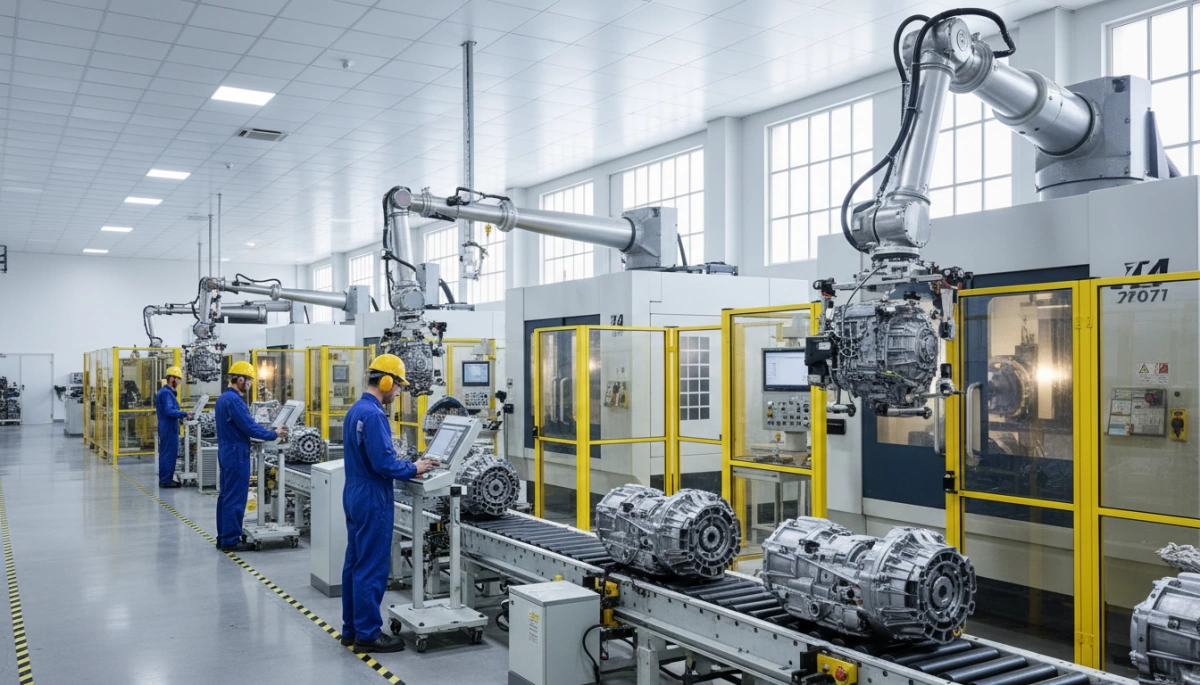
Are you struggling with production bottlenecks, inconsistent build quality, or untraceable defects in your powertrain manufacturing? The era of relying on isolated, manual workstations is over. Today’s competitive manufacturing landscape requires a definitive shift toward a fully automated, data-driven ecosystem. When we engineer high-performance transmission assembly equipment, our primary focus is eliminating human error and maximizing throughput through smart, seamless integration.
To construct a truly modern assembly architecture, we rely on three core technological pillars:
Agility dictates production success on the factory floor. We deploy flexible ring lines and advanced multi-station assembly equipment to keep your production moving without interruption. This modular conveyor approach allows your facility to adapt instantly to different transmission variants, ensuring continuous, optimized workflow layouts that scale seamlessly as your production volumes shift.
Precision is non-negotiable when seating complex gearsets, shafts, and sensitive casings. Our automation solutions heavily integrate high-speed robotic part handling alongside highly engineered part-feeding mechanisms.
You cannot optimize what you cannot trace. Our automotive manufacturing automation lines are anchored by robust intelligent control systems (PLC) that manage multi-station data in real-time. To safeguard your quality standards, we natively embed RFID part tracking manufacturing protocols directly into the production sequence. This creates a digital footprint for every unit, guaranteeing 100% full traceability and component accountability from the first bolt down to the final offload.
Transmissions operate under extreme fluid pressure. Even a microscopic casing leak can lead to catastrophic failure on the road, resulting in massive warranty claims and a hit to your reputation. You simply cannot afford to treat assembly and testing as two separate steps.
If you silo your quality checks, you waste time and money tearing down faulty builds that should never have made it down the line. Modern transmission assembly equipment must have testing built directly into the manufacturing process.
Catching flaws early is the only way to protect your bottom line and maintain speed. We embed precise testing directly into the assembly flow:
Before any transmission leaves the line, it requires a full functional shakedown. Our gearbox performance testing verifies the mechanics under real-world conditions.
By integrating these exact checks directly into the line, we ensure that if a transmission doesn’t perform flawlessly, it doesn’t leave the floor.
The shift from traditional internal combustion engines (ICE) to electric vehicles (EV) demands entirely new manufacturing approaches. Building parts for an electric powertrain is fundamentally different from building for gas engines, requiring upgraded machinery and smarter processes.
EV reducers and transmissions operate under unique conditions that require highly specialized handling on the factory floor:
This shift is exactly why we leverage our deep expertise in battery manufacturing to build better powertrain systems. At Upton, we design forward-thinking transmission assembly equipment that directly addresses the complex nuances of both hybrid and fully electric powertrains. By integrating advanced automotive manufacturing automation right into your plant floor, we ensure your facility hits the exact noise, performance, and quality targets required to lead in today’s global EV market.
When upgrading your transmission assembly equipment, picking the right supplier makes or breaks the project. I always advise production managers to look beyond the basic spec sheet. You need a reliable partner who delivers true turnkey assembly solutions, not just hardware.
Here is exactly what you should look for when vetting suppliers:
