Address
Bldg-1, No.19, Yunpu 1st Road, Huangpu District, Guangzhou, Guangdong, China, 510530
Work Hours
Monday to Friday: 8:30AM - 5:30PM
Address
Bldg-1, No.19, Yunpu 1st Road, Huangpu District, Guangzhou, Guangdong, China, 510530
Work Hours
Monday to Friday: 8:30AM - 5:30PM

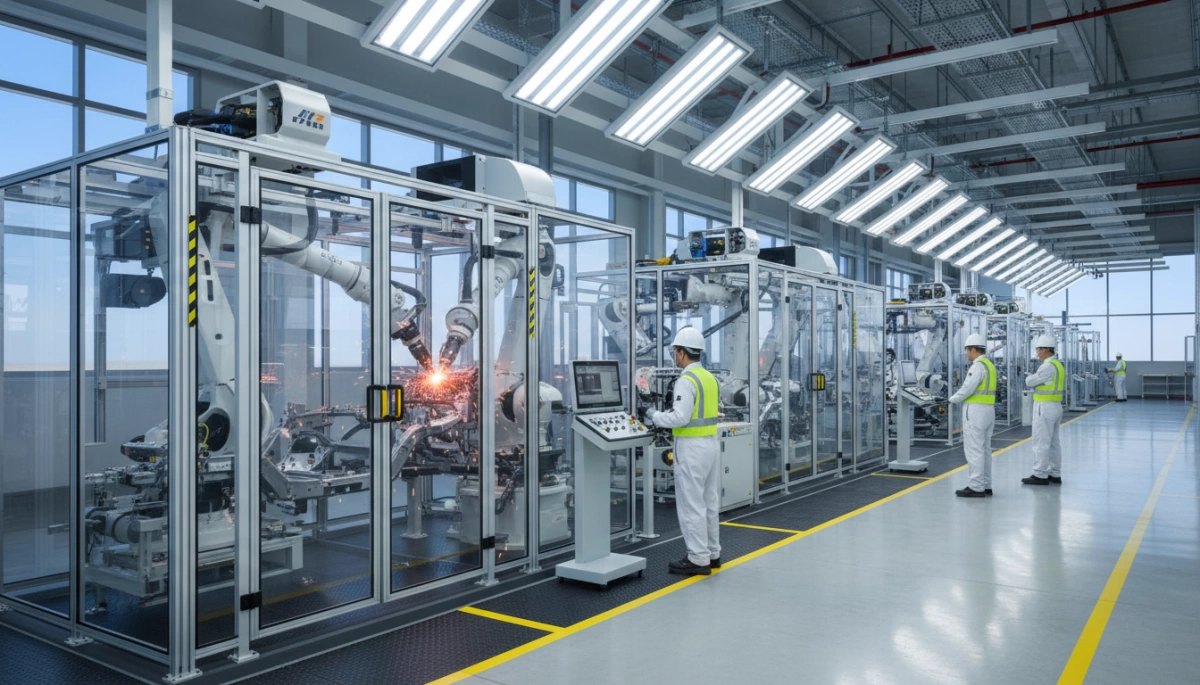
Are your daily floor meetings dominated by missed OEM quotas, unpredictable defect rates, and ergonomic injury reports? As manufacturing engineers, we see these exact hurdles crippling plant operations every day. The traditional manual manufacturing playbook simply cannot keep pace with modern volume demands. Implementing targeted automotive assembly automation is how we shift your facility from reactive firefighting to proactive, highly predictable output.
Here is exactly how we engineer solutions to the industry’s toughest operational bottlenecks.
Missing a stringent OEM production quota is not an option. We integrate heavy-duty robotic assembly systems and synchronized conveyors to systematically eliminate manual workflow bottlenecks. By standardizing the physical handoffs between stations, we lock in aggressive, predictable cycle times and guarantee the high-volume throughput required to stay competitive.
The era of relying on subjective manual spot-checks is over. To achieve a zero-defect manufacturing standard, we build automated, inline testing directly into your production flow.
Relying on human labor for heavy lifting and repetitive, high-torque tasks is a massive liability. We design systems that absorb the dangerous, physically punishing work. This allows you to reassign your operators away from high-risk tasks and into high-value supervisory, programming, and maintenance roles—drastically improving factory ergonomics and reducing worker compensation claims.
Market demands shift rapidly, and dedicated, rigid lines are a financial sinkhole. We engineer modular setups and utilize agile tooling so your facility can pivot seamlessly. This inherent flexibility means your plant can switch production between entirely different vehicle models without facing massive, crippling downtime.
The Automation Impact on the Factory Floor
| Production Challenge | Traditional Manual Line | Automated Assembly Solution |
|---|---|---|
| Throughput | Fluctuating output based on shift fatigue | Locked-in, highly predictable cycle times |
| Quality | Subjective, reactive manual inspections | 100% automated, objective inline verification |
| Safety | High risk of repetitive strain and injury | Operators shifted to safe, supervisory roles |
| Agility | Weeks of downtime required for retooling | Modular setups for rapid vehicle model changeovers |
To stay competitive globally, we rely on advanced technology to keep our production lines moving fast and flawlessly. Here is a breakdown of the core systems driving the modern shop floor.
We use a strategic mix of heavy-payload industrial arms and smart cobots to balance raw power with flexibility.
Driving strict automotive quality control means eliminating guesswork. We integrate smart sensors and optical technology directly into the line for absolute accuracy.
Manual material handling creates massive bottlenecks. We use AMRs to automate and streamline our internal logistics. These mobile units ensure just-in-time (JIT) parts delivery directly to the operators, keeping automotive parts manufacturing perfectly paced and eliminating costly floor wait times.
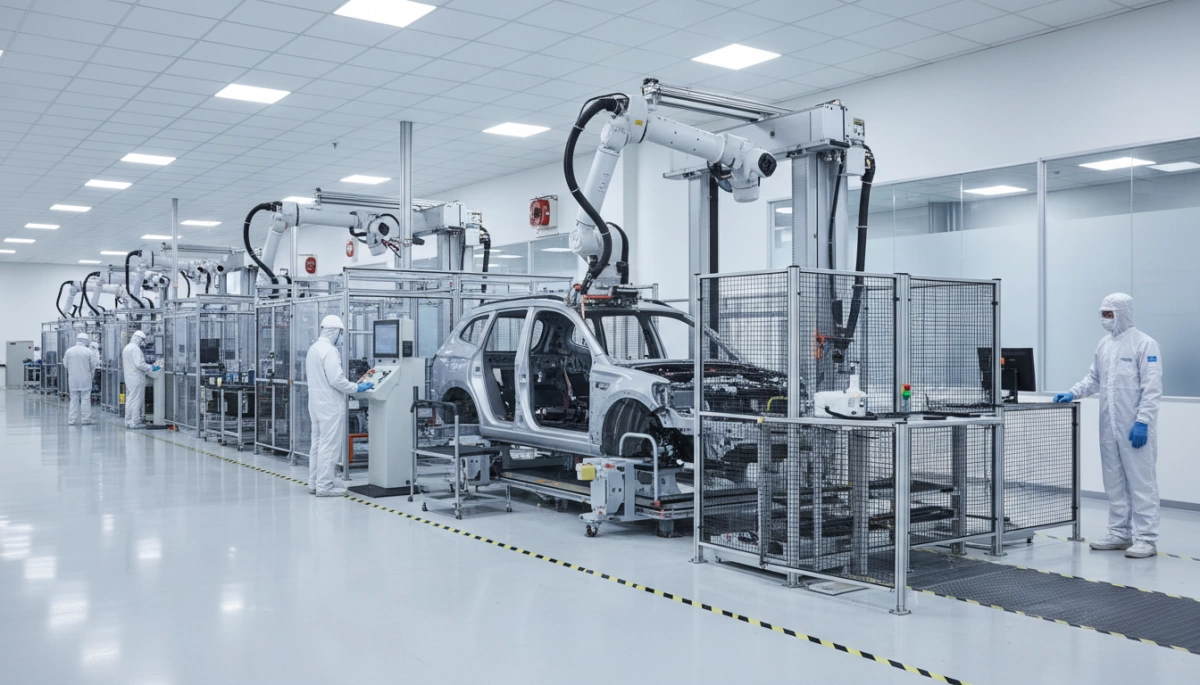
The shift to electric vehicles isn’t just a design update—it requires a completely new playbook. Unlike traditional combustion engines, EV architecture demands a fundamentally different approach to automotive parts manufacturing. We are trading mechanical complexity for high-voltage, electrochemical precision, and our production lines must adapt to handle this shift.
When building a vehicle’s power architecture, there is zero margin for error. Our approach to battery module assembly focuses on absolute precision at every single step to guarantee performance and safety.
You can’t just build an EV; you have to prove it’s safe before it leaves the factory floor. We integrate rigorous End-of-line (EOL) testing directly into the automated workflow.
| Testing Focus | Purpose on the Assembly Line |
|---|---|
| Safety Protocols | Verifies high-voltage isolation and structural integrity to protect end-users. |
| Performance Checks | Confirms the assembled battery pack delivers the correct power output. |
| Workflow Integration | Tests run inline without slowing down the overall automotive assembly automation process. |
By building these automated testing protocols directly into the production line, we guarantee safety and performance without sacrificing our manufacturing speed.
When we build an EV battery assembly line, there is absolutely zero tolerance for leaks. A single drop of fluid or the tiniest gas escape is a critical failure. For new energy vehicles, absolute containment is a strict safety mandate. We rely on fast, accurate automated leak detection systems integrated directly into the workflow to guarantee every unit is completely sealed before it moves forward.
To achieve a zero-defect standard, our automotive assembly automation setups deploy multiple layers of defense:
Standard methods often fall short during complex battery module assembly. That is exactly why we utilize the MSQ2000 Electrolyte Leak Test System. This proprietary technology is built to tackle the unique structural vulnerabilities of modern EV batteries head-on. By instantly sniffing out escaping electrolyte vapors rather than just pressure changes, the MSQ2000 delivers absolute containment validation, setting a new safety benchmark for automotive parts manufacturing.
Upgrading your line is a massive investment. Finding the right partner to execute that vision is non-negotiable. Based on what we demand for our own global operations, here is exactly what you need to look for to ensure your automotive assembly automation project succeeds.
You cannot afford to have vendors learning on your time.
Juggling multiple contractors is a recipe for delays and blame games.
In this industry, extended downtime drains your budget.
