Address
Bldg-1, No.19, Yunpu 1st Road, Huangpu District, Guangzhou, Guangdong, China, 510530
Work Hours
Monday to Friday: 8:30AM - 5:30PM
Address
Bldg-1, No.19, Yunpu 1st Road, Huangpu District, Guangzhou, Guangdong, China, 510530
Work Hours
Monday to Friday: 8:30AM - 5:30PM

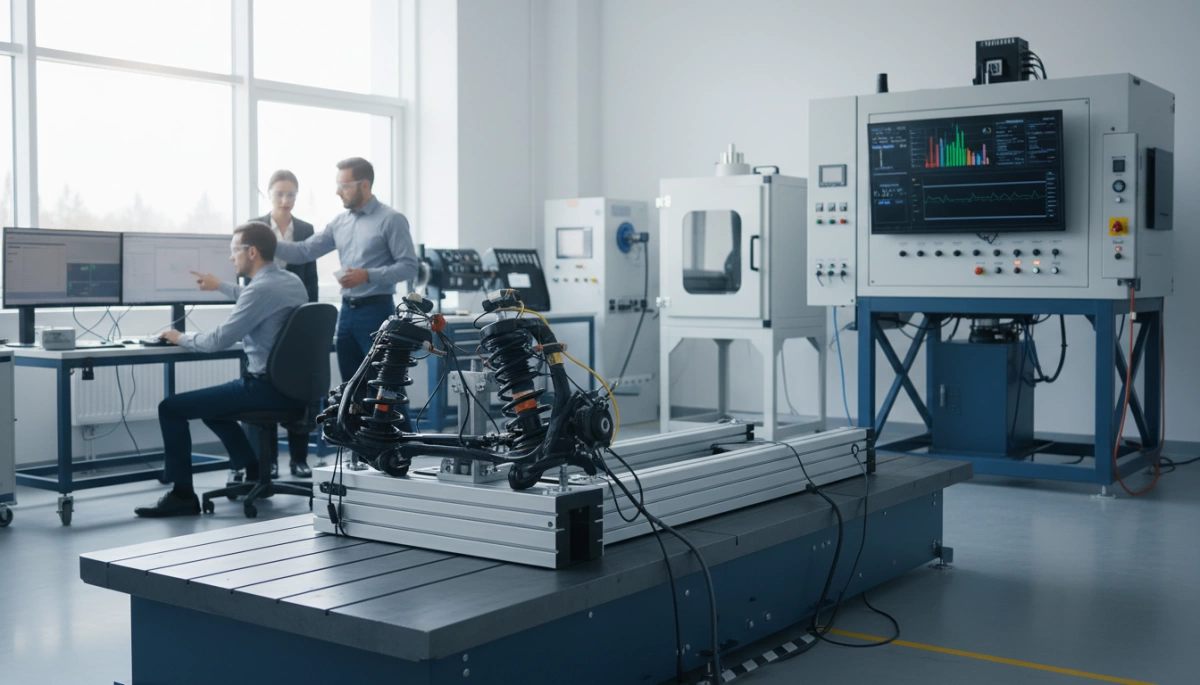
Are you struggling to maintain zero-defect production while scaling up your high-speed assembly lines?
In modern manufacturing, reliable automotive component testing isn’t just a standard quality gate—it’s absolutely non-negotiable for vehicle safety, continuous throughput, and protecting your brand’s reputation.
As an industry veteran with over two decades in high-tech automation, I know that relying on outdated manual sampling is a recipe for costly recalls. Furthermore, the rapid shift toward electric vehicles (EVs) has completely rewritten the rulebook, making precision testing more critical and complex than ever before.
In this complete guide, you’re going to learn exactly how to navigate stringent OEM standards, implement advanced leak detection protocols, and integrate 100% automated in-process testing directly into your manufacturing lines.
If you are looking to eliminate production bottlenecks and future-proof your quality control strategy, this guide is for you.
Let’s dive right in.
Are you confident your parts will survive a decade of harsh road conditions, or are you risking a catastrophic, multi-million dollar recall? In our industry, assumptions are dangerous. We rely on rigorous automotive component testing to validate every single part before it ever hits the assembly line, transforming potential liabilities into guaranteed performance.
We design and execute testing protocols with three primary goals in mind. It is about pushing parts to their absolute limits to guarantee uncompromising automotive quality assurance.
Building safe, reliable vehicles means putting every part through the wringer. In our operations, we rely on a few core methodologies to guarantee top-tier automotive quality control. Here is how we validate parts for the real world.
Modern cars are essentially rolling computers. We must ensure these electronics function flawlessly despite external electromagnetic interference. By testing against strict standards like ISO 11452, we make sure critical vehicle sensors and control units never glitch when it matters most.
We simulate years of harsh driving in just a few days. By applying extreme stress, dynamic impacts, and constant vibration, we see exactly how physical parts hold up under pressure.
Vehicles face brutal weather conditions globally. Our automotive test systems push components to their absolute limits to check for resilience against:
Fluid and gas containment is a non-negotiable quality gate in automotive manufacturing. If a component leaks, the system fails. We deploy advanced leak detection equipment to catch microscopic faults early in the production cycle.
Micro-Leak Testing Methods Compared:
| Testing Method | Best Used For | Sensitivity Level |
|---|---|---|
| Air Leak Testing | Standard fluid paths and fast cycle times | Moderate |
| Helium Leak Detection | High-precision micro-leak detection | Extremely High |
| Tracer Gas | Complex, hard-to-reach assembly joints | High |
Applying the right testing mix ensures that every single component meets the highest safety and performance standards.
Electric vehicles completely flipped the script on traditional automotive component testing. We are no longer just looking at mechanical wear and tear or exhaust emissions. Today, electric vehicle component validation centers heavily on the battery, requiring completely new testing standards to ensure absolute safety and long-term performance.
When we handle battery module assembly, safety is our top priority. We must balance high-speed production throughput with zero-tolerance quality control. Even a microscopic flaw can lead to catastrophic failures. The two biggest threats we test against are:
Traditional leak detection equipment falls short for modern EV battery testing. Standard air decay methods often miss the specific, complex chemical signatures of battery fluids.
Traditional vs. Advanced EV Leak Testing
| Testing Method | Limitations & Capabilities |
|---|---|
| Traditional Air Testing | Lacks the sensitivity to catch micro-leaks of complex chemical solvents. Often fails to detect actual liquid escape. |
| Advanced Electrolyte Leak Testing | Specifically engineered to sniff out trace amounts of battery fluid, ensuring unacceptable leakage is caught immediately. |
We deploy advanced automotive test systems focused directly on electrolyte detection. This specialized approach is the only way to guarantee battery integrity, prevent thermal events on the road, and maintain high-speed manufacturing without compromising safety.
Sending parts to an off-site lab for automotive component testing creates massive bottlenecks. We bypass these production delays by integrating In-Process Testing (IPT) directly into the manufacturing flow. Instead of waiting days for third-party lab results or relying solely on End-of-line (EOL) testing, we bring rigorous quality checks right to the assembly line.
To maintain high-speed production without sacrificing accuracy, we deploy advanced automotive test systems exactly where the manufacturing happens.
Achieving flawless automotive quality control requires marrying the build process with the validation process. We create a seamless synergy between assembly automation and test technology. This fully integrated approach guarantees that quality is built into the component at every single stage, delivering a safer, more reliable product to the global market.
When Tier 1 suppliers and OEMs search for an automation partner, the stakes are incredibly high. You need more than just a vendor; you need a strategic ally who understands the deep complexities of automotive assembly automation and reliable automotive quality control.
Here is exactly what you must demand from your testing equipment partner:
This is exactly where we excel. At Upton, we bring over 20 years of dedicated high-tech group experience directly to your production floor. We specialize in engineering precision automotive component testing equipment designed to seamlessly meet and exceed rigorous OEM testing standards. We do not just supply machinery; we partner with you to deliver confidence, speed, and absolute accuracy, keeping your manufacturing lines moving safely and efficiently for the Global market.
What is the most critical testing standard for automotive components? There isn’t a single standard, as it heavily depends on the part. In our experience, baseline OEM testing standards and international benchmarks like ISO (such as ISO 11452 for electromagnetic compatibility) govern the industry. Hitting these specific marks is non-negotiable for strict automotive quality assurance and global compliance.
How does EV battery testing differ from traditional combustion engine part testing? The shift is massive. Traditional component durability testing focuses heavily on mechanical wear, vibration, and oil containment. Electric vehicle component validation, however, centers entirely on high-voltage safety, absolute moisture control, and highly sensitive electrolyte leak testing. While a standard mechanical engine part might survive a minor pressure drop, a high-density battery module assembly cannot tolerate any fault.
What are the benefits of In-Process Testing (IPT) over End-of-Line (EOL) testing? When we build and integrate automotive test systems, we push for IPT to maximize efficiency:
Folding IPT directly into your automotive assembly automation guarantees smarter automotive quality control and much higher yield rates.
How can automated leak detection prevent EV battery thermal runaway? Thermal runaway frequently triggers from a compromised battery seal that allows moisture in or hazardous gases out. We utilize automated leak detection equipment—specifically precision helium leak detection on our automated test benches—to spot microscopic defects before the battery ever leaves the factory floor. Finding the micro-leak guarantees the structural integrity of the cell, directly preventing the conditions that cause thermal runaway.
