Address
Bldg-1, No.19, Yunpu 1st Road, Huangpu District, Guangzhou, Guangdong, China, 510530

Work Hours
Monday to Friday: 8:30AM - 5:30PM

Cell Assembly Automation Guide for HighPrecision EV Production-2

What is Cell Assembly Automation?

Struggling to hit high-volume yield targets without compromising quality? We see this bottleneck across the industry. Cell assembly automation is the integration of precision robotics, high-speed material handling, and advanced automated vision systems to manufacture battery and fuel cells flawlessly.

As the backbone of a modern EV battery assembly line, reliable automation turns chaotic manual processes into predictable, high-yield manufacturing. We engineer turnkey lithium-ion cell manufacturing equipment designed to eliminate micro-defects, protect sensitive materials, and keep your cycle times razor-sharp.

Format Flexibility in Modern Automation

A single production strategy doesn’t fit every chemistry or form factor. To scale effectively, your automation must adapt to specific structural and handling demands:
  • Cylindrical Cells: Built for high-speed continuous motion. A competitive cylindrical battery production line requires absolute synchronization at hundreds of parts per minute without material jamming or alignment failures.
  • Pouch Cells: Demands highly delicate handling and precise vacuum sealing to prevent structural stress on soft, vulnerable casings.
  • Prismatic Cells: Prismatic cell manufacturing relies on heavy-duty rigid casing management and ±0.1mm tolerance laser welding to guarantee long-term structural integrity.
  • Hydrogen Fuel Cells: Robotic fuel cell assembly requires specialized end-effectors to precisely manipulate highly porous, fragile substrates without inducing micro-tears or contamination.

Top 3 Challenges Solved by Cell Assembly Automation

cell assembly automation challenges solved

Stepping up from a small pilot project to a full-scale EV battery assembly line brings a host of hurdles. In my experience providing turnkey automation solutions, relying on outdated machinery simply doesn’t cut it in today’s market. We rely on intelligent cell assembly automation to directly tackle the industry’s most expensive and dangerous manufacturing roadblocks.

Eliminating Micro-Defects with Automated Vision Inspection Systems

Even the smallest alignment error can lead to a rejected cell or, worse, catastrophic thermal runaway. We have to catch these mistakes before they leave the line.

  • Extreme Precision: Delivering ±0.1mm placement accuracy ensures every single component fits exactly where it needs to.
  • Zero Compromise on Quality: By integrating automated vision inspection systems, we monitor the line in real-time, catching microscopic defects that the human eye misses.
  • Maximized Yield: Stopping errors instantly means less scrap, exceptionally high yield rates, and a significantly safer final product.

Safe Handling via Precision Material Handling Robotics

Dealing with reactive and fragile materials is a constant headache in lithium-ion cell manufacturing equipment. You need aggressive speed, but you also need a remarkably delicate touch.

  • No Tearing or Stress: Thin lithium foils and delicate hydrogen membranes break easily under tension. Precision material handling robotics grip and move these substrates without causing micro-tears.
  • High-Speed Stability: We push production limits, smoothly running lines at 200+ units per minute while keeping these sensitive materials completely intact.
  • Operator Safety: Automated, hands-free transfer keeps highly reactive materials secure and isolates the workforce from potential hazards.

Achieving True Battery Production Scalability

Building a few perfect batteries is easy; building millions flawlessly is the real test. To make your investment in gigafactory automation equipment actually pay off, you need systems designed for global mass production from day one.

  • Consistent Cycle Times: Automation locks in highly reliable output rates, ensuring you hit aggressive production quotas every single shift without fatigue.
  • Minimized Downtime: Smart robotics keep the line moving continuously, dramatically slashing unexpected stops and maintenance delays.
  • Seamless Expansion: Whether you are upgrading a pilot line or rolling out a massive new facility, true battery production scalability lets you ramp up your volume without ever sacrificing cell quality.

Inside Our Cell Assembly Automation Line

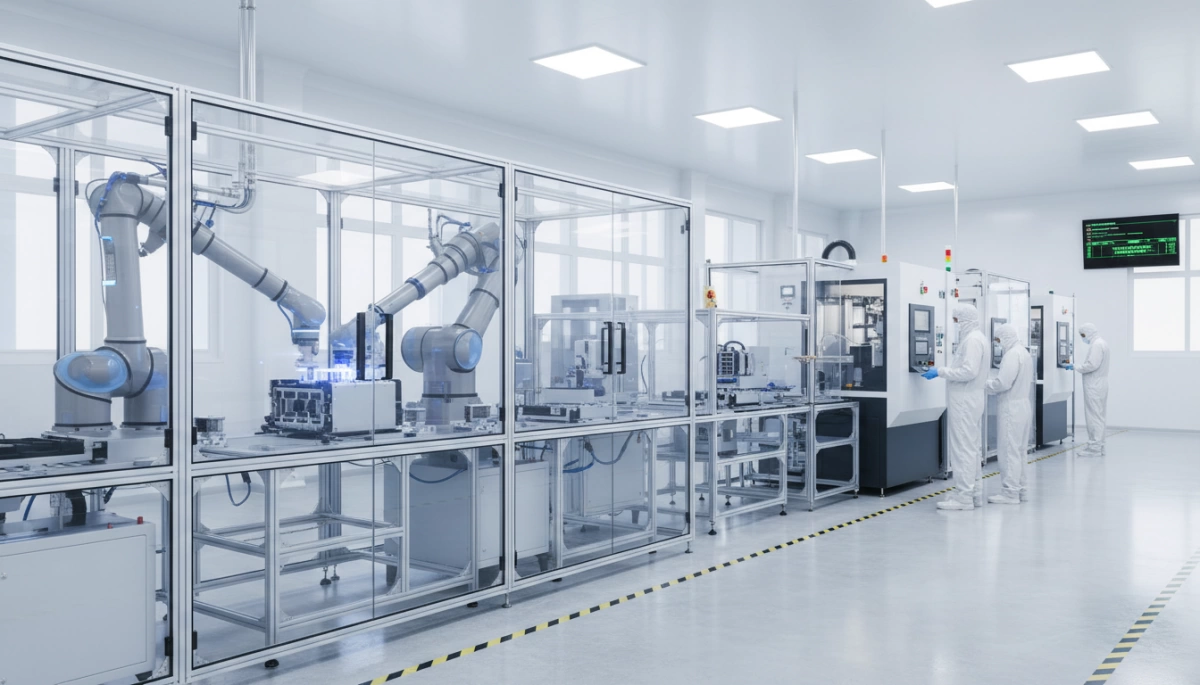
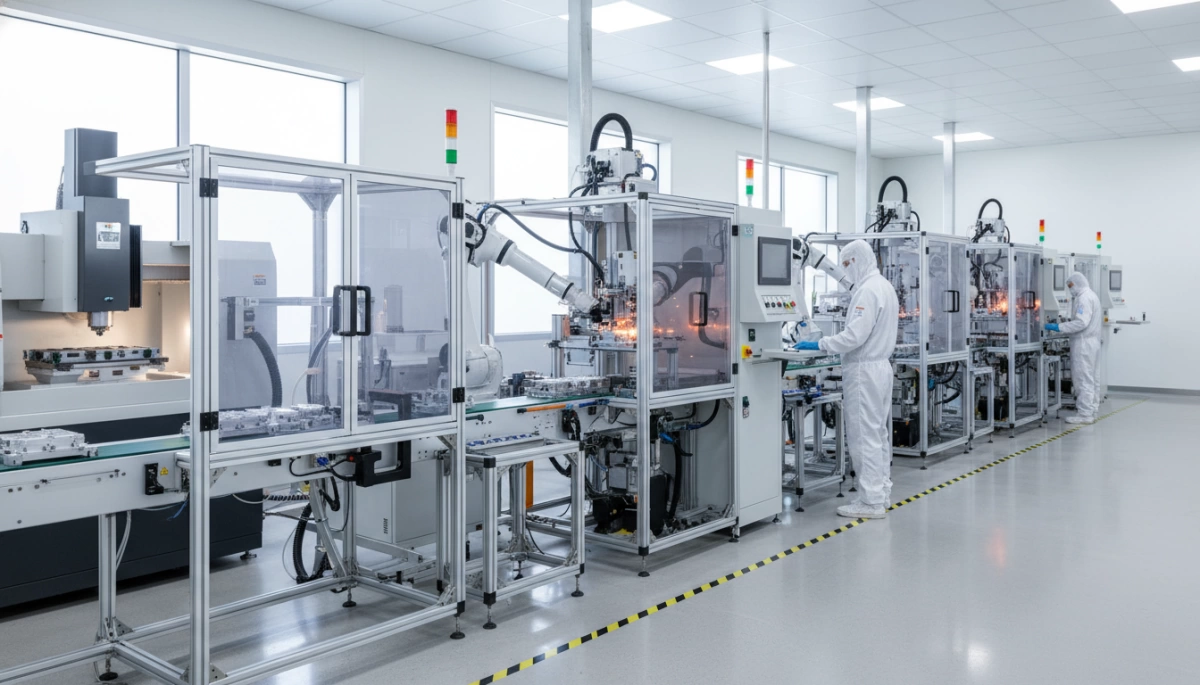
When we set up an EV battery assembly line, it is all about precision flow. A modern intelligent system relies on heavily integrated stages, powered by the latest lithium-ion cell manufacturing equipment. We design these systems so that every micro-movement adds value and ensures absolute safety.

Here is the exact step-by-step breakdown of how our cell assembly automation process works on the factory floor:

  • Electrode Preparation and Sorting: We start by getting the raw materials ready. Automated vision inspection systems quickly scan, grade, and sort the electrodes. This ensures only physically flawless components move forward, catching expensive defects before assembly even begins.
  • Forming the Cell Core: The battery format dictates the machinery used here. For a cylindrical battery production line, we rely on high-speed battery winding to tightly coil the materials without tearing the foils. If the line is built for pouch or prismatic formats, we utilize precise Z-stacking automation to build perfectly aligned layers.
  • Tab Welding and Cell Insertion: Once the core is formed, automated systems step in to handle the tab welding, creating solid electrical connections. Next, precision material handling robotics carefully take the delicate internal core and insert it into its final outer casing, whether that is a rigid metal can or a flexible foil pouch.
  • Electrolyte Filling and Sealing: The final assembly step requires strict environmental control. The automated system precisely injects the required volume of electrolyte fluid into the casing. Immediately after filling, the cell is permanently sealed to lock out moisture, prevent contamination, and prepare the unit for the crucial testing phases.

Cell Assembly Automation: Testing and Leak Detection

In cell assembly automation, building the battery is only half the job. We know that a high-performing EV battery assembly line must prioritize safety and compliance above all else. Without rigorous, integrated testing, even the fastest production line fails. Quality testing is simply non-negotiable.

Advanced Leak Testing Technologies

To guarantee the reliability of our lithium-ion cell manufacturing equipment, we integrate three core testing methods to ensure every unit is road-ready:

  • Air Leak Testing: We rely on this for rapid, preliminary structural integrity checks. It acts as your critical first line of defense on the factory floor.
  • Helium Leak Detection Batteries: We deploy precision helium testing to spot micro-leaks. This step is vital for meeting the demanding power architectures of today’s electric vehicles.
  • Electrolyte Leak Test System: We built specialized tools like our proprietary MSQ2000 specifically to detect unacceptable electrolyte leakage. This guarantees absolute battery safety and compliance for new energy vehicles.

Choosing Your Cell Assembly Automation Partner

Scaling your battery production requires more than just buying off-the-shelf robots. When you invest in cell assembly automation, you need a comprehensive integration ecosystem that works seamlessly from day one.

As experts in the field, we know that building a successful production line means finding a true partner. Here is what you must demand to guarantee success in the global market.

Turnkey Automation Solutions

Do not piece together your line from a dozen different vendors. You need end-to-end systems that manage everything under one roof. From initial material singulation to the final testing and grading process, a unified system ensures your lithium-ion cell manufacturing equipment runs smoothly without integration bottlenecks.

20+ Years of Engineering Expertise

Experience is your best defense against costly downtime and low yield rates. We bring over two decades of hands-on experience in designing high-tech intelligent equipment. Whether you are ramping up a cylindrical battery production line or deploying full-scale gigafactory automation equipment, this deep engineering track record is what turns pilot projects into massive commercial successes.

Rapid Deployment for Fast Time-to-Market

The energy market moves incredibly fast. Aggressive time-to-market demands require rapid deployment capabilities. Strong project management ensures fast delivery, getting your equipment installed, validated, and producing cells right on schedule.

Partner Evaluation Criteria

Core CapabilityWhy It Matters for Your Production
End-to-End SystemsEliminates communication and software headaches between different machines.
Proven Track Record20+ years of expertise guarantees battery production scalability and safety.
Agile Project ManagementRapid deployment gets your final product to market faster.
Integrated EcosystemsMoves beyond standard robotics into fully unified, intelligent manufacturing.

Related Sources

https://www.uson.com/blog/air-leak-testing-vs-helium-leak-testing-for-ev-battery-applications
https://www.inficon.com/en/news/five-important-facts-for-direct-electrolyte-leak-testing