Address
Bldg-1, No.19, Yunpu 1st Road, Huangpu District, Guangzhou, Guangdong, China, 510530
Work Hours
Monday to Friday: 8:30AM - 5:30PM
Address
Bldg-1, No.19, Yunpu 1st Road, Huangpu District, Guangzhou, Guangdong, China, 510530
Work Hours
Monday to Friday: 8:30AM - 5:30PM
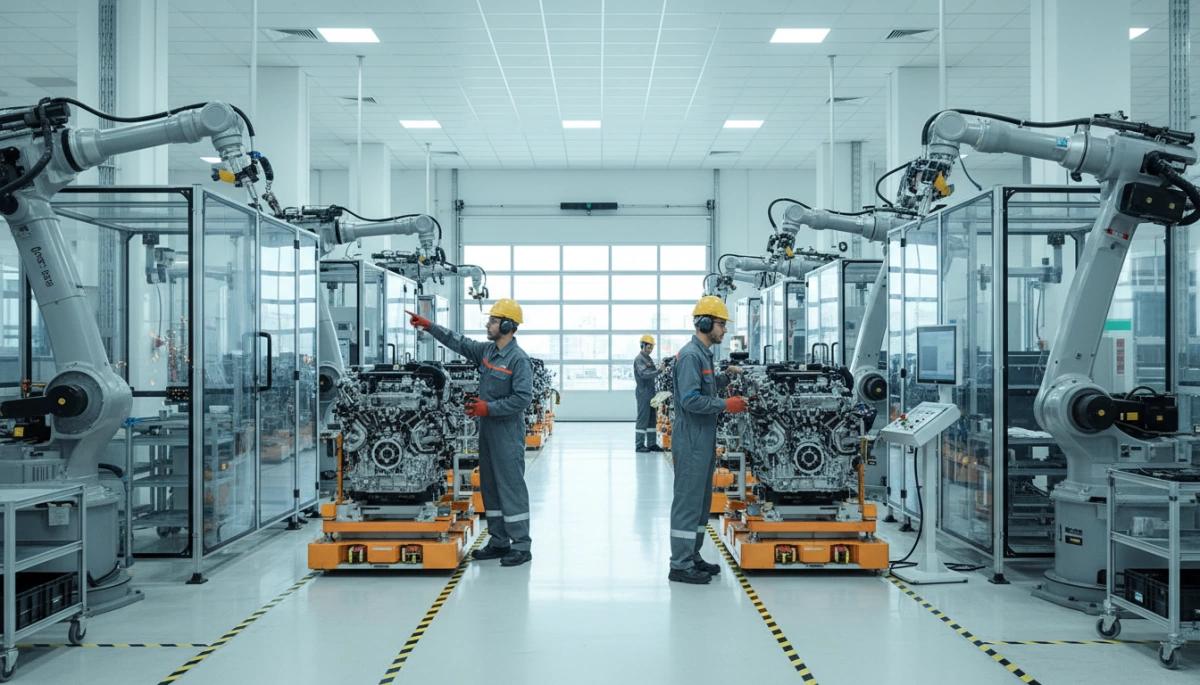
You might already know that building a modern engine requires absolute precision and zero margin for error…
But how do top-tier manufacturers actually achieve it without killing their throughput?
Well, you’re in for a treat because I’ve broken down the exact anatomy of a modern engine assembly line.
As an automation expert, I know that relying on outdated manual methods destroys your efficiency. Upgrading your engine production line with the right automated assembly systems isn’t just a smart investment—it’s the only way to stay competitive.
In this guide, you’re going to learn exactly how engines are built step-by-step, from bare block preparation to final dress.
More importantly, I’ll show you how integrating turnkey automation solutions and rigorous leak testing drives serious cycle time optimization and guarantees zero defects.
So whether you are an engineer looking to upgrade your facility, or you simply want to see how the heart of a machine comes to life, this guide is for you.
Let’s dive right in.
Are you struggling to maintain consistent quality and cycle times across your engine production line? Balancing pinpoint precision with high-volume output is the biggest hurdle in the modern automotive manufacturing process. We know that a single misaligned component or missed torque target can derail your entire operation, leading to costly recalls and downtime. To combat this, we rely on a highly structured, error-proof workflow. Here is exactly how we execute the engine build from bare metal to a fully dressed powerhouse.
To maximize efficiency and eliminate defects, we break the engine assembly line down into four critical phases. Each stage utilizes advanced automated assembly systems to guarantee repeatability and speed.
The foundation of a reliable engine starts with the block. If the base is compromised, the entire build fails. We focus heavily on precise seating and securing in this initial stage.
With the crankshaft secured, we move directly into the short block assembly. This phase integrates the core rotational mass of the engine.
Converting the short block into a long block requires an absolute seal. Proper cylinder head installation is non-negotiable for achieving and holding combustion compression.
In the final mechanical phase, we turn the sealed long block into a complete, drop-in ready unit. This is where the engine gets its breathing and electrical components.
| Component Group | Assembly Actions |
|---|---|
| Air Management | Bolting on the intake and exhaust manifolds using torque-controlled drivers to prevent vacuum or exhaust leaks. |
| Fuel & Ignition | Installing the fuel rails, direct injectors, spark plugs, and ignition coils. |
| Accessory Drive | Mounting the water pump, alternator, AC compressor, and routing the serpentine belt. |
By strictly controlling these four phases, we ensure every engine moving down the line is built to exact specifications, fully prepped for the subsequent leak detection and testing phases.
To stay competitive, we rely on advanced automated assembly systems. Building reliable motors at scale means eliminating guesswork and maximizing speed. Here is the core technology powering our engine assembly line today.
We pair heavy-duty robotics with smart conveyor networks. This keeps the entire engine production line moving fast and smooth.
Mistakes cost time and money. We build poka-yoke error proofing directly into our workstations so bad parts never move forward.
Market demands shift fast. We design our systems with mixed-model flexibility so we can adapt without costly downtime.
| Flexibility Feature | Impact on Production |
|---|---|
| Seamless Switching | Build a V6 directly behind a 4-cylinder on the same line. |
| Smart Tooling | Automated fixtures adapt to different engine blocks on the fly. |
| Cycle Time Optimization | Maintains maximum output regardless of the specific model being built. |
By leaning into mixed-model production, we keep output high and overhead low, delivering exactly what the market needs right on schedule.
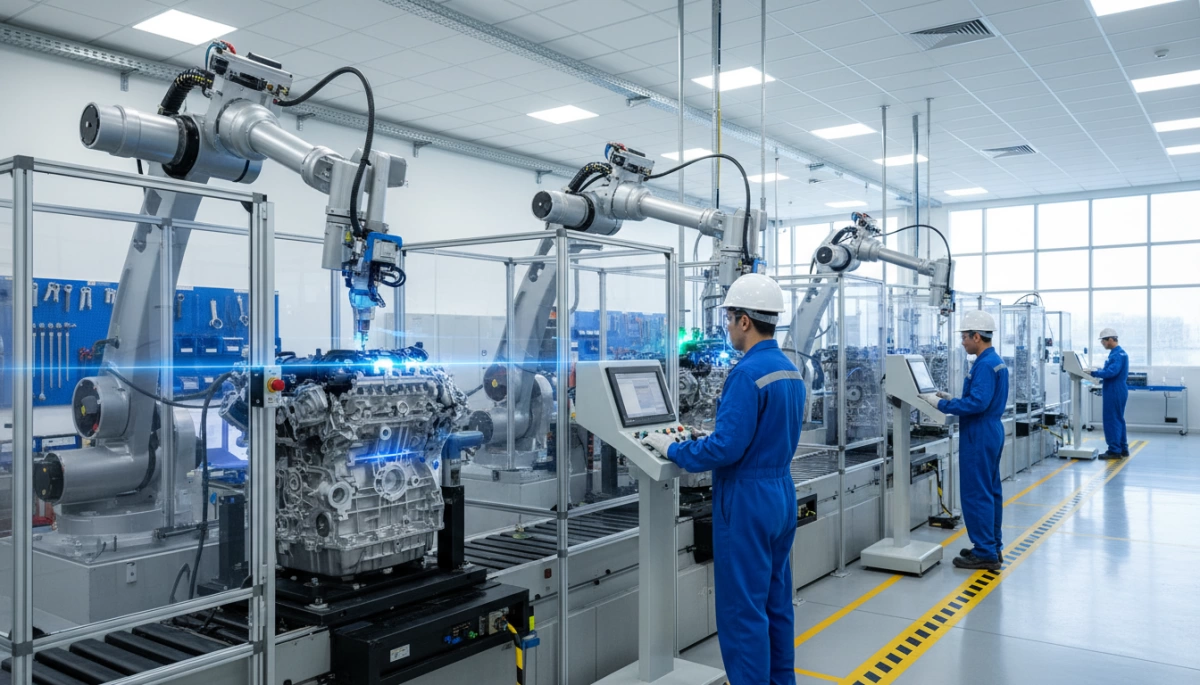
When we build an engine, precision is everything. We enforce a strict zero-tolerance policy for fluid and gas leaks. A single seal failure can compromise the entire powertrain, which is why rigorous end-of-line testing is built directly into our automated systems.
To guarantee absolute structural integrity, we rely on two primary methods of leak detection technology:
Before an engine leaves the facility, it has to prove it runs flawlessly. We use two distinct validation methods to verify mechanical and functional performance:
| Test Method | Process | Main Advantage |
|---|---|---|
| Cold Testing | An external motor spins the engine without introducing fuel or spark. Sensors monitor oil pressure, timing, torque, and friction. | Fast, safe, and eco-friendly. Modern cold testing equipment significantly optimizes cycle times. |
| Hot Testing | The engine is hooked up to fuel and coolant, ignited, and run under its own power. | Proves real-world combustion, exhaust output, and overall firing dynamics. |
When building a reliable engine assembly line, you need a team that knows the automotive manufacturing process inside and out. At Upton, we provide exactly that.
Here is why manufacturers trust us to build their automated assembly systems:
We don’t just supply equipment; we build the solutions that keep your production moving.
Thanks to advanced cycle time optimization and automated assembly systems, modern lines move incredibly fast. While a single engine block might take a few hours to travel from start to finish, a fully completed engine typically rolls off the engine assembly line every 1 to 3 minutes. It is all about maintaining a steady, high-speed flow without compromising quality.
These are two completely different but crucial stages in end-of-line testing:
Automated cameras serve as the ultimate poka-yoke error proofing tool on the engine production line. High-resolution vision systems scan components in milliseconds to:
If a camera spots a flaw, the system flags the part and pauses the station immediately, guaranteeing zero defects pass down the line.
Mixed-model production is a major advantage in the modern automotive manufacturing process. It means our assembly line does not have to shut down and retool just to switch from building a standard 4-cylinder engine to a hybrid V6. The line’s integrated robotics instantly read the incoming engine block’s barcode and automatically adjust their programming, tooling, and parts selection to build completely different engine variants back-to-back.
