Address
Bldg-1, No.19, Yunpu 1st Road, Huangpu District, Guangzhou, Guangdong, China, 510530
Work Hours
Monday to Friday: 8:30AM - 5:30PM
Address
Bldg-1, No.19, Yunpu 1st Road, Huangpu District, Guangzhou, Guangdong, China, 510530
Work Hours
Monday to Friday: 8:30AM - 5:30PM

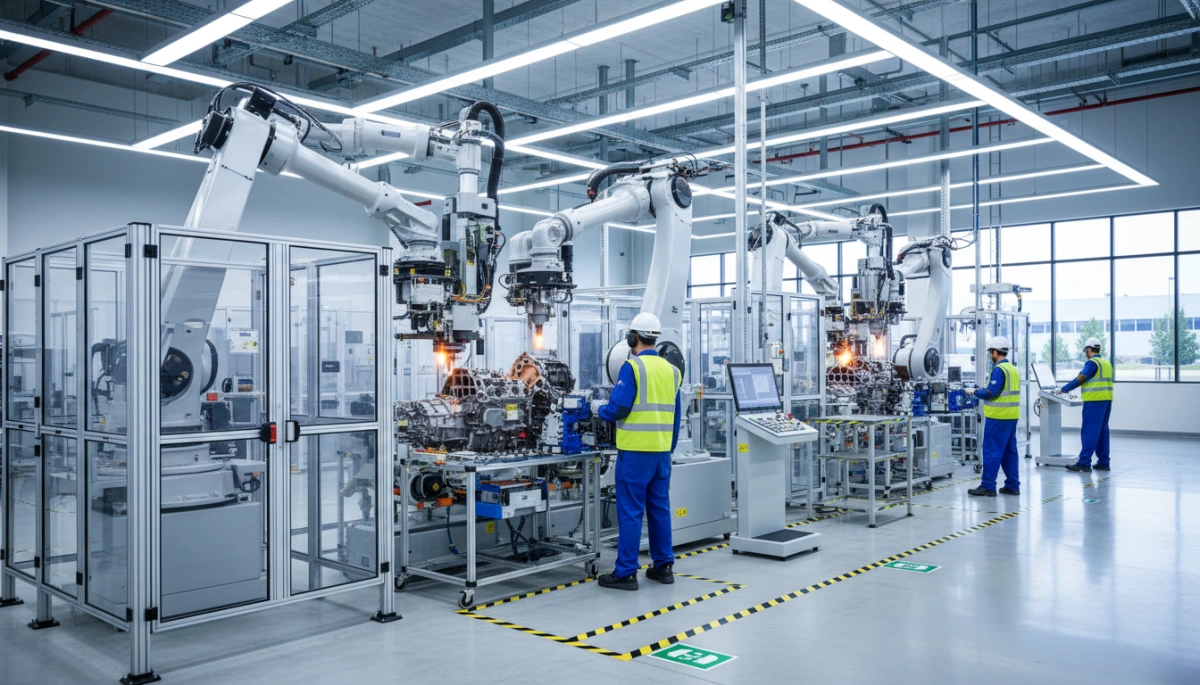
Are you struggling to keep pace with the rapid shift from traditional engines to electric vehicles without halting your production? You aren’t alone. The automotive landscape is shifting fast, and staying competitive means rethinking how we build cars from the ground up.
As a business owner deeply involved in manufacturing innovation, I see firsthand how the transition from Internal Combustion Engines (ICE) to Hybrid and EV platforms is rewriting the rulebook. The structural differences in assembly requirements are massive, and pretending otherwise is a fast track to falling behind.
When we look at modern powertrain assembly systems, the core challenge is handling entirely new components safely and efficiently.
| Feature | Traditional ICE Lines | Modern EV Lines |
|---|---|---|
| Core Components | Engine blocks, fluid systems | Electric motors, heavy battery modules |
| Safety Focus | Standard mechanical safety | Strict high-voltage safety protocols |
| Infrastructure | Traditional routing | Heavy-duty lifts, specialized automated assembly lines |
This reality forces a tough decision: do you retrofit legacy lines or invest in purpose-built solutions? While retrofitting an existing setup for hybrid powertrain manufacturing might seem cost-effective initially, it often introduces severe bottlenecks. Purpose-built EV lines are engineered from day one to handle the extreme weight and complex safety demands of EV battery assembly and motor assembly automation.
Let me be clear: rigid assembly lines are obsolete. You simply cannot survive with a static, inflexible setup when market demands fluctuate wildly month to month.
To thrive today, we must prioritize adaptability over permanence. A static production floor locks you into yesterday’s market. By implementing modular layouts, you gain the agility to pivot seamlessly.
Building a modern facility means expecting the unexpected. Your powertrain assembly system must be flexible enough to bend so your business doesn’t break.
When we build and scale automotive production facilities globally, we face a fresh set of hurdles. The rapid industry shift means our powertrain assembly systems must overcome three major manufacturing bottlenecks to stay competitive and profitable.
The specific demands of EV battery assembly and electric motor production require pinpoint accuracy. We are no longer just bolting basic metal parts together.
Intense global competition is squeezing production timelines. We are constantly pressured to get automated assembly lines up and running faster than ever before.
Recording every single detail of the build is now a strict requirement. We rely heavily on deep MES data traceability to keep operations compliant, safe, and transparent.
To build reliable powertrain assembly systems, we rely on a strategic mix of hardware and software. The most effective manufacturing setups share a core set of advanced components designed for speed, precision, and safety.
We balance manual, semi-automated, and fully automated assembly lines to maximize production flow. At the center of this is the robotic assembly process.
Manufacturing errors lead to costly downtime. To prevent this, our systems integrate comprehensive quality assurance poka-yoke mechanisms directly into the workflow. We deploy automated visual inspections to verify component placement in real-time, ensuring zero defects pass through the station.
Powertrain integrity is non-negotiable. We embed critical automotive test technology into the assembly line to validate every unit.
Reliable leak test systems are mandatory, especially for hybrid and electric vehicles:
Modern facilities run on reliable data. We enforce deep MES data traceability by integrating Manufacturing Execution Systems across the entire floor. This setup captures real-time data, tracks individual component torque specs, and logs all test results. By securing this data, we ensure strict regulatory compliance, predict maintenance before machines fail, and continuously optimize Overall Equipment Effectiveness (OEE).
When setting up modern manufacturing floors, piecing together equipment from a dozen different vendors is a recipe for delays and downtime. To stay competitive globally, we rely heavily on the strategic advantage of turnkey automation solutions.
Working with a single integrator for both assembly and automotive test technology provides a massive operational edge. Instead of managing competing contractors, you get seamless end-to-end capabilities from day one.
You simply cannot afford expensive layout mistakes once the equipment hits the factory floor. We use virtual commissioning to eliminate that physical risk entirely.
This comprehensive, end-to-end approach guarantees that when your physical equipment is finally installed, your powertrain assembly systems are fully optimized and ready to run.
When we invest in manufacturing infrastructure, we are not just solving for today’s production quotas. We need facilities that can pivot instantly when market demands shift. Whether you are scaling up electric platforms or maintaining legacy ICE outputs, keeping your facility adaptable is the only way to survive. Here is how we ensure our lines are ready for what is next.
Before upgrading or building a new facility, run through this baseline checklist to ensure long-term viability:
A reliable partner makes or breaks your launch timeline. When evaluating providers for turnkey automation solutions, I judge them strictly on three core factors:
Think of it as the core engine of automotive manufacturing. We use these automated assembly lines to build the critical components that drive a vehicle. Whether we are dealing with a standard engine or a complex electric setup, these systems seamlessly piece together the components into a fully functional unit ready for the road.
The manufacturing requirements have shifted dramatically:
Vehicle safety and long-term performance depend entirely on perfect seals.
A Manufacturing Execution System (MES) acts as the digital brain of the modern production floor.
We do not wait for the physical equipment to arrive to test a new layout. By utilizing virtual commissioning, we build a complete 3D digital twin of the assembly line.
