Address
Bldg-1, No.19, Yunpu 1st Road, Huangpu District, Guangzhou, Guangdong, China, 510530
Work Hours
Monday to Friday: 8:30AM - 5:30PM
Address
Bldg-1, No.19, Yunpu 1st Road, Huangpu District, Guangzhou, Guangdong, China, 510530
Work Hours
Monday to Friday: 8:30AM - 5:30PM

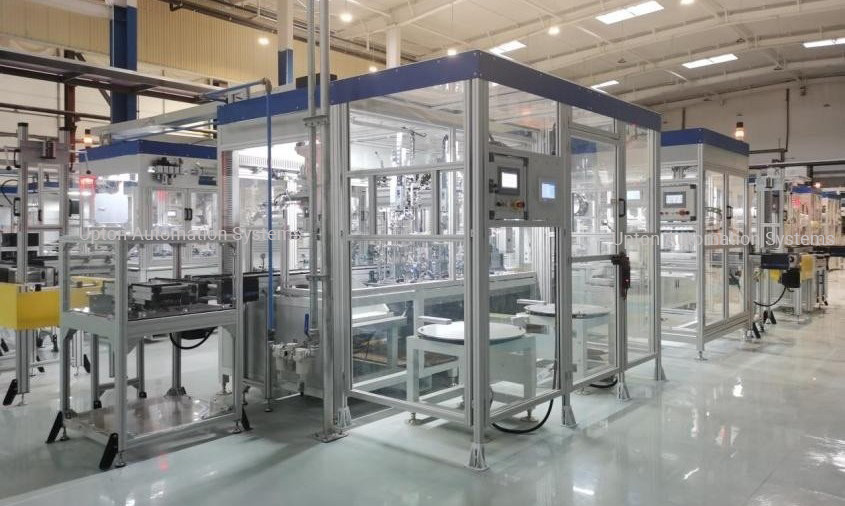
Ensuring the absolute seal integrity of cylindrical cells is one of the most critical steps in modern lithium-ion battery leak testing. Unlike other formats, cylindrical cells present unique physical and operational hurdles that make detecting defects incredibly difficult. As manufacturers scale up production, we face three primary challenges in securing battery cell seal integrity.
Evaluating rigid steel or aluminum canisters requires an entirely different approach than testing flexible pouch cells.
The window between a perfectly sealed cell and a defective one is microscopic. For high-capacity formats like the 18650 cell or the newer 4680 cylindrical cell, even a microscopic pathways can cause devastating field failures over time.
In modern high-speed battery manufacturing, accuracy cannot come at the expense of throughput. Incorporating non-destructive battery inspection into a fast-paced environment creates a massive engineering bottleneck.
| Factor | Challenge | Impact on Quality Control |
| Tact Time | High-volume lines output dozens of cells per minute. | Traditional vacuum chamber leak testing cycles can be too slow for inline integration. |
| Handling Damage | Rapidly loading and unloading cells into test chambers risks damaging the cap or seal. | Deforms the very seals we are trying to inspect, creating false positives or missed leaks. |
| System Balance | Balancing high sensitivity with rapid cycle times. | Finding a trace gas or vapor analysis solution that can clear the chamber and reset instantly for the next cycle. |
Overcoming these barriers requires dedicated cylindrical battery leak detection equipment engineered specifically to handle rigid structures, locate sub-micron paths, and match the intense rhythm of automated inline production lines.
Choosing the right cylindrical battery leak detection equipment depends on your production volume, accuracy needs, and budget. We use three main methods across the industry to catch defects before cells leave the factory.
This is the gold standard for high-speed lithium-ion battery leak testing. Before the final seal, a small amount of helium is injected into the cell.
If you don’t want to inject tracer gas, we look for what is already inside the cell: the electrolyte itself.
This method relies on air pressure differentials in a tightly controlled vacuum environment to verify battery cell seal integrity.
| Technology | Detection Target | Best Used For | Sensitivity Level |
| Helium Vacuum Leak Test | Helium Gas | Ultra-fast inline scanning | Highest ($10^{-6}$ mbar·l/s) |
| Direct Electrolyte Detection | Solvent Vapor (VOCs) | EOL quality checks | High |
| Mass Extraction | Air / Gas Flow | Structural seal verification | Medium-High |
When investing in cylindrical battery leak detection equipment, selecting the right machine directly impacts your yield and line efficiency. We look at four critical pillars to ensure the system handles the pressures of high-volume lithium-ion battery leak testing.
An automated inline leak tester must match the upstream cell assembly speed without creating bottlenecks. The equipment needs seamless robotic handling interface protocols and quick-clamping mechanisms to handle thousands of parts per hour during battery end-of-line (EOL) testing.
The physical layout of the vacuum chamber dictates your cycle times. Optimized chamber volume minimizes the dead space around the cells, which accelerates vacuum pull-down times and sharpens the signal-to-noise ratio for precision detection.
A reliable tester requires built-in reference leaks to guarantee consistent data. The system must automatically self-calibrate at set intervals to eliminate environmental drift and maintain a stable micro-leak rejection rate across three shifts.
Our proprietary engineering addresses the exact vulnerabilities of high-speed cylindrical cell manufacturing. We design our cylindrical battery leak detection equipment to maximize throughput while maintaining absolute accuracy.
| Feature | Standard Market Systems | upton Inline Systems |
| Chamber Cycle Time | 4 to 6 seconds | Under 2.5 seconds |
| Minimum Detectable Leak | $1 times 10^{-5}text{ mbar}cdottext{l/s}$ | Up to $1 times 10^{-6}text{ mbar}cdottext{l/s}$ |
| Calibration Frequency | Manual / Shiftly | Automated / In-line real-time |
| Tooling Changeover | 30 to 45 minutes | Less than 10 minutes (Toolless) |
Core Benefit: By drastically reducing the vacuum chamber volume and embedding high-speed mass spectrometer leak detector modules, our system ensures your 18650 or 4680 production line runs at full capacity without risking battery cell seal integrity.
Every cylindrical cell we manufacture must meet strict international quality benchmarks. To ensure safety and long-term reliability, our cylindrical battery leak detection equipment operates under rigid compliance frameworks and precise measurement standards.
Setting the exact boundary between a safe cell and a reject is critical for lithium-ion battery leak testing.
Our automated inline leak tester systems are engineered to align with top-tier international automotive and energy storage standards:
| Standard / Framework | Focus Area |
| UN 38.3 | Transport safety and structural integrity under vacuum conditions |
| SAE J2464 / UL 2580 | Abuse testing and EV battery cell seal integrity |
| GB/T Standards | Regional compliance for global market access |
In modern 4680 cylindrical cell manufacturing and 18650 cell quality control, data is just as important as the physical test. Our equipment automatically logs every test result, tying the precise leak rate data to the cell’s unique barcode. This creates a foolproof digital twin for every batch, ensuring 100% traceability during battery end-of-line (EOL) testing and protecting your brand from liability.
Pressure decay testing works by filling a space with air and watching for a drop in pressure. While it is cheap and simple, it completely fails the lithium-ion battery leak testing standard for cylindrical cells.
If a micro-leak bypasses your battery end-of-line (EOL) testing, the consequences show up months later in the field. It is a slow-motion disaster for safety and performance.
High-volume 4680 cylindrical cell manufacturing demands cycle times under a few seconds. Our upton automated inline leak tester meets this head-on by re-engineering the traditional vacuum chamber leak testing workflow.
